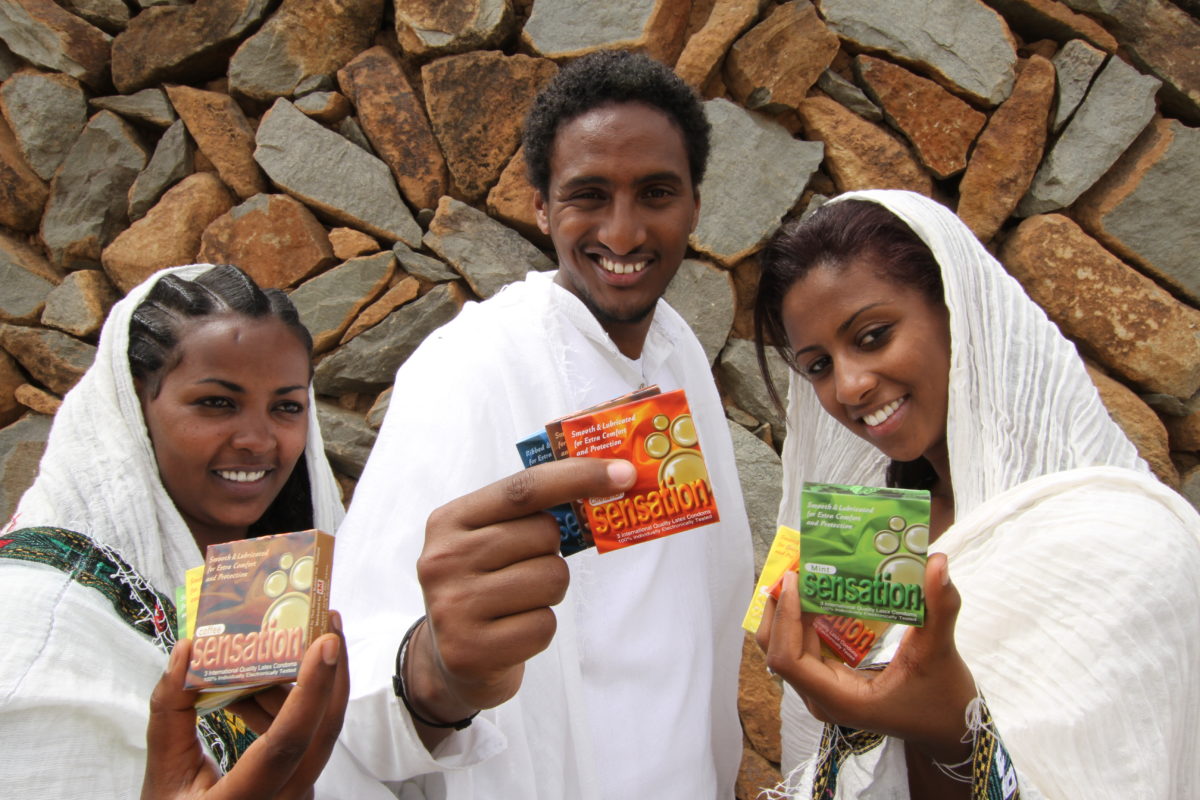
Ethiopia is DKT’s first country program, started in 1990. Since then, Ethiopia has made remarkable progress towards improving access to and use of contraceptives. The contraceptive prevalence rate for married women increased dramatically from 3% in 1990 to 38% in 2020. However, much work remains to be done, as 14% of women want to use contraception but lack access.
The 2012 UN AIDS Report on the Global AIDS Epidemic noted the progress Ethiopia has made in fighting HIV from 2001-2011, when new infections dropped by 90%, the largest drop of any country in Africa and the second greatest in the world. What’s more, the 2011 Ethiopia Demographic and Health Survey reported HIV prevalence at a relatively modest 1.5%. However, HIV is still a significant challenge for Ethiopia and much work remains.
DKT Ethiopia began operations with the introduction of Hiwot Trust condoms and now offers six condom brands, oral contraceptives, injectables, emergency contraceptives and several other health products. In 2019 DKT contributed over 25 percentage points of modern contraceptive prevalence (mCPR) of the country’s 38%, giving DKT Ethiopia a 68% share of modern contraceptive prevalence for the country as a whole. This makes DKT Ethiopia the single largest private provider of contraceptives and family planning services in the country.
DKT Ethiopia engages burgeoning entrepreneurs through its youth program, the Young Marketers Initiative, a collaboration that includes 150 HIV/AIDS prevention clubs of student entrepreneurs who sell condoms to their peers. The Young Marketers clubs regularly account for a third of DKT Ethiopia’s condom sales. The clubs continue to be sources of talent; DKT Ethiopia has hired Young Marketers as full-time sales staff. In 2019 Young Marketers sold 22 million condoms while Youth Ambassadors educated over 100,000 young people on family planning.
DKT Ethiopia is a leading creator of innovative programming and behavior change campaigns. DKT Ethiopia’s Wise-Up Program is one of Africa’s largest HIV prevention programs targeting to sex workers. DKT also launched Temarinet, a social media platform for university students to engage in discussions about sexual and relationships.